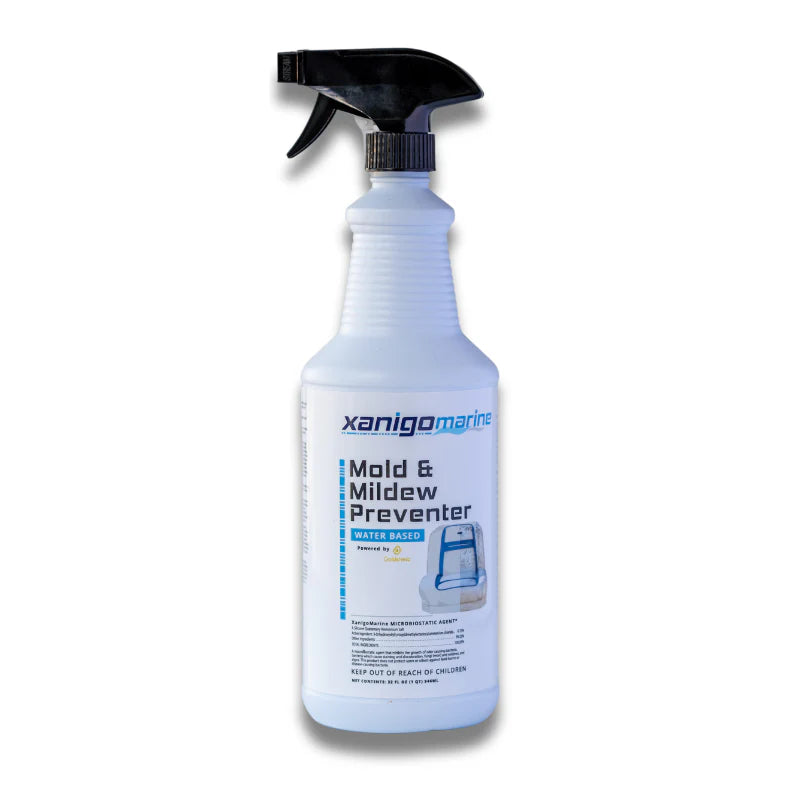
Xanigo Mold & Mildew Preventer: The 90-Day Protection Your Antigua Boat Needs
Xanigo Mold & Mildew Preventer is one of the most important products you can carry on a Caribbean boat.
March 13, 2026
TL;DR: Mold and mildew are relentless in Antigua's tropical climate. Scrubbing every week isn't a solution — prevention is. Xanigo Mold & Mildew Preventer uses a patented organosilane compound powered by Goldshield that bonds to your boat surfaces at a molecular level, blocking mold and mildew growth for up to 90 days per application. Spray it onto clean, dry surfaces. No wiping required. Available now at Antigua Marine Solutions.
You pull back the cover. Three weeks since you were last aboard. And there it is again: black spots creeping across the cushions, that damp musty smell, a grey fuzz forming in the Bimini fold.
This is Antigua. Humidity sits between 70 and 85 percent for most of the year. The temperature never drops far enough to slow mold growth. If your boat is sitting closed up, mold is already working. Cleaning it is only half the battle. Mold and mildew spores are virtually everywhere in tropical air, and all they need to colonize a surface is moisture, warmth, and something organic to feed on. Boats provide all three in abundance.
That's why Xanigo Mold & Mildew Preventer is one of the most important products you can carry on a Caribbean boat. It doesn't just clean. It prevents. One application creates a protective barrier that stops mold from taking hold for up to 90 days. This post explains exactly how it works, where to use it, and how to get the most out of every bottle.
Why Does Mold Hit So Hard in the Caribbean?
Mold thrives whenever humidity stays above 60 percent, surfaces are warm, and air circulation is limited. On a boat in Antigua, all three conditions are present every single day of the year.
Keeping indoor humidity below 60 percent is considered the key threshold for mold prevention in tropical climates — but the Caribbean rarely cooperates. Step below deck on a boat that's been closed up for a few days and you'll often find conditions well above that threshold: warm, still air, moisture trapped in cushions, condensation on fibreglass. It's a perfect incubator.
There's no seasonal reset here either. In northern climates, cold winters kill off or slow mold growth significantly. Antigua has no such break. The cycle runs twelve months a year, which means a boat that isn't actively protected will lose the battle eventually. As humidity and temperatures rise across the Caribbean, mold and spore abundance directly impacts air quality and the condition of everything they touch.
The problem spots on most Caribbean boats are the same: cockpit cushion undersides, Bimini folds, anchor lockers, storage compartments, and any canvas left folded after rain. These areas stay damp and dark long after everything else dries out.
Cleaning removes mold. Prevention stops it from coming back.
What Is Xanigo and How Does It Actually Work?
Xanigo Mold & Mildew Preventer is an EPA-approved, water-based organosilane solution that bonds molecularly to treated surfaces and physically destroys mold and mildew spores on contact for up to 90 days.
The active chemistry — a patented organosilane compound powered by Goldshield — isn't a conventional disinfectant. It doesn't evaporate after drying. Instead, organosilane molecules covalently bond to the treated surface as the product dries, creating a durable, non-leaching antimicrobial coating that remains active long after application.
Here's what's actually happening at the surface level. The organosilane molecule has three functional parts: a silane anchor that bonds to the surface, a positively charged nitrogen atom, and a long molecular "spear." When a mold spore contacts the treated surface, the positively charged nitrogen draws it in while the hydrocarbon spear pierces its cell membrane, destroying it through physical disruption rather than chemical leaching. Because the kill mechanism is physical, not chemical, it doesn't promote resistant strains.
What makes Xanigo particularly well-suited to boats is its formulation. It's water-based (the only water-based organosilane of its kind), contains no alcohol, is non-flammable, and is safe for the surfaces found throughout a typical vessel. It's also odourless once dry. You don't need special protective equipment to apply it.
The result is long-lasting residual protection that keeps working between boat visits, even when the boat is closed up and humidity is building.
Where Should You Apply Xanigo on Your Boat?
Xanigo is designed for any high-moisture surface that's vulnerable to mold or mildew. On a Caribbean boat, that covers a lot of ground.
Vinyl cushions and seating are the most obvious target. Cockpit seats, helm chairs, and salon settees are constantly exposed to salt spray, sweat, and humidity. These are the surfaces most boat owners notice mold on first.
Canvas surfaces — Biminis, sail covers, cockpit enclosures, dodger panels — are prime real estate for mildew. The weave traps moisture and provides organic material for spores to feed on. Xanigo's Mold & Mildew Preventer is effective on seats, life jackets, canvas, ropes, carpet, and all areas with high moisture.
Lines and rope are an often-overlooked surface. Dock lines coiled in lockers, halyards on a furled sail — these go damp regularly and rarely fully dry.
Life jackets and PFDs are another surface that sees a lot of moisture and storage time. Xanigo handles them without issue.
Carpet and soft flooring in cockpits, companionways, and interior spaces all respond well to treatment.
Interior surfaces — berth cushions, headliners in the cabin, storage locker linings — benefit from a quarterly application, especially on liveaboards.
For stubborn existing growth before applying Xanigo, use Starke Mildew Clean first to remove active mold, then apply the preventer once the surface is dry. Clean surface in, protected surface out.
The 3-Step System: Remove, Prevent, Maintain
The most effective approach to mold on a Caribbean boat isn't reactive — it's systematic. Remove what's there, prevent it from returning, and maintain the treatment with the right cleaners.
Step 1: Remove. If you have existing mold or mildew, clear it first. Xanigo's Mold & Mildew Preventer is designed for prevention, not removal — if active mold is present, treat with a mold remover first, then apply the preventer once the surface is clean. Starke Mildew Clean is the right first step here: spray on a cool, shaded surface, let it soak, and the mold disappears without scrubbing.
Step 2: Prevent. Once the surface is clean and dry, apply Xanigo. Spray an even layer onto the surface. Spread it with a microfiber cloth. Let it air dry fully. That's the treatment locked in. Done correctly, it provides up to 90 days of residual protection.
Step 3: Maintain. This is the step most people miss. Certain cleaners will inactivate the Mold & Mildew Preventer — Xanigo recommends using only pH-neutral soaps and water-based cleaners to keep the treatment active between reapplications. Using an incompatible cleaner strips the organosilane layer and ends your protection early. Stick to pH-neutral products between treatments.
Pair this system with good ventilation habits — open hatches when aboard, use solar vents when away, never cover a damp boat — and you'll see a real difference in how clean your surfaces stay.
Browse the full range of marine-grade detailing products at Antigua Marine Solutions to build out your complete kit.
How Long Does the Protection Last in Antigua's Climate?
One application of Xanigo Mold & Mildew Preventer provides up to 90 days of residual protection. In Antigua's year-round tropical conditions, a quarterly reapplication schedule keeps your boat continuously covered.
The 90-day duration reflects the general industry consensus for organosilane-based antimicrobial treatments on low-abrasion surfaces. Areas that see heavy use, regular cleaning, or abrasion will see the treatment wear down more quickly. Interior cushions that are sat on daily will need reapplication sooner than, say, a sail cover that only gets handled a few times a month.
In practice, the quarterly rhythm works well for most Antigua boat owners. Apply in January, April, July, and October and you maintain continuous coverage through the full year. Mark it on your boat maintenance calendar alongside oil changes and antifouling. It's the same kind of routine maintenance that prevents expensive problems later.
Hull growth from mold and algae can increase fuel consumption by up to 30 percent on heavily fouled vessels. On a boat used regularly in Antigua, staying ahead of growth isn't just about aesthetics. It's about efficiency and the long-term condition of your surfaces. Left untreated, mildew weakens canvas, degrades vinyl, and creates persistent odours that are difficult to eliminate without complete interior cleaning.
The math is simple. A bottle of Xanigo used four times a year costs far less than replacing cushions, repairing canvas, or deep-cleaning a neglected interior.
What Cleaners Are Safe to Use After Applying Xanigo?
This is where a lot of boat owners unknowingly undo their own work. After applying Xanigo, the products you use to clean your boat between treatments matter.
The organosilane layer is durable, but it can be stripped by the wrong cleaners. Harsh chemical cleaners, bleach-based products, high-pH soaps, and many standard household cleaning sprays will degrade the treatment before the 90 days are up. Xanigo specifically recommends pH-neutral soaps and water-based cleaners to keep the Mold & Mildew Preventer active between applications.
For regular boat washing in between Xanigo applications, Starke Pure Clean is a good fit. It's a pH-neutral marine soap formulated not to strip waxes or sealants, which makes it compatible with surface treatments like Xanigo. Use it as your standard maintenance wash and you'll preserve both the cleanliness of the boat and the active prevention layer.
If you're unsure whether a cleaner is compatible, the test is simple: check the pH. Anything neutral (pH 7, or close to it) is safe. Anything alkaline or acid-based is a risk. Bleach is a hard no — it's both chemically incompatible with organosilane treatments and damaging to the marine vinyl surfaces underneath.
Connect with certified marine detailers in Antigua who use and recommend the full Starke and Xanigo system if you want professional application and advice for your specific vessel.
Conclusion
Three things to take away from this post.
First, cleaning mold is not the same as preventing it. Mildew Clean removes what's there. Xanigo stops it from coming back for up to 90 days. You need both in your kit.
Second, the science works. Xanigo's organosilane compound bonds physically to surfaces and destroys spores on contact. It doesn't evaporate. It doesn't wash off with rain. Applied correctly and maintained with compatible cleaners, it stays active.
Third, in Antigua's year-round tropical climate, prevention isn't optional maintenance. It's essential maintenance. Quarterly applications of Xanigo cost a fraction of what you'll spend replacing mold-damaged canvas, cushions, and interior surfaces.
Your boat deserves better than a scrub brush and a prayer. Give it real protection.
Frequently Asked Questions
Does Xanigo remove existing mold, or just prevent it?
Xanigo Mold & Mildew Preventer is designed for prevention, not removal. It effectively prevents mold and mildew for 90 days per application but does not serve as a mold remover. If you have active mold on your surfaces, use a dedicated mold remover like Starke Mildew Clean first. Once the surface is clean and fully dry, apply Xanigo to protect it going forward. Trying to apply Xanigo over existing mold will trap growth under the treatment layer and reduce its effectiveness.
How do I apply Xanigo Mold & Mildew Preventer?
Make sure the surface is clean and fully dry before you start. Spray an even layer of Xanigo onto the surface and spread it evenly with a clean microfiber towel. Allow it to air dry completely — this is when the organosilane molecules bond to the surface. For best results, apply with an atomizer sprayer, which uses 3–4 times less solution than a standard pump sprayer and provides more even coverage. No wiping or buffing required after drying.
How often do I need to reapply Xanigo in a tropical climate?
Every 90 days is the standard interval. The organosilane compound provides long-lasting residual protection, with re-application recommended approximately every 90 days for low-abrasion surfaces. In Antigua's climate, a quarterly schedule — four treatments per year — gives you continuous year-round coverage. Surfaces that see heavier use or more frequent cleaning may need reapplication closer to the 60-day mark.
Is Xanigo safe for vinyl boat seats and canvas?
Yes. Xanigo Mold & Mildew Preventer is safe for use on vinyl boat seats, life jackets, canvas, ropes, carpet, and all high-moisture areas. The formula is water-based, contains no alcohol, and is non-flammable. It's designed specifically for marine applications where contact with a wide variety of materials is unavoidable. As a precaution with any new product, testing on a small inconspicuous area first is always a good habit on older or heavily weathered surfaces.
Can I use bleach or regular cleaners after applying Xanigo?
No. Bleach and harsh chemical cleaners will strip the organosilane treatment from your surfaces. Xanigo recommends using only pH-neutral soaps and water-based cleaners to keep the Mold & Mildew Preventer active between treatments. Using incompatible products means losing your 90-day protection early and having to reapply sooner. Stick to marine-grade, pH-neutral cleaners for routine washes and you'll preserve the full benefit of each Xanigo application.
Featured Product
Xanigo Mold & Mildew Preventer