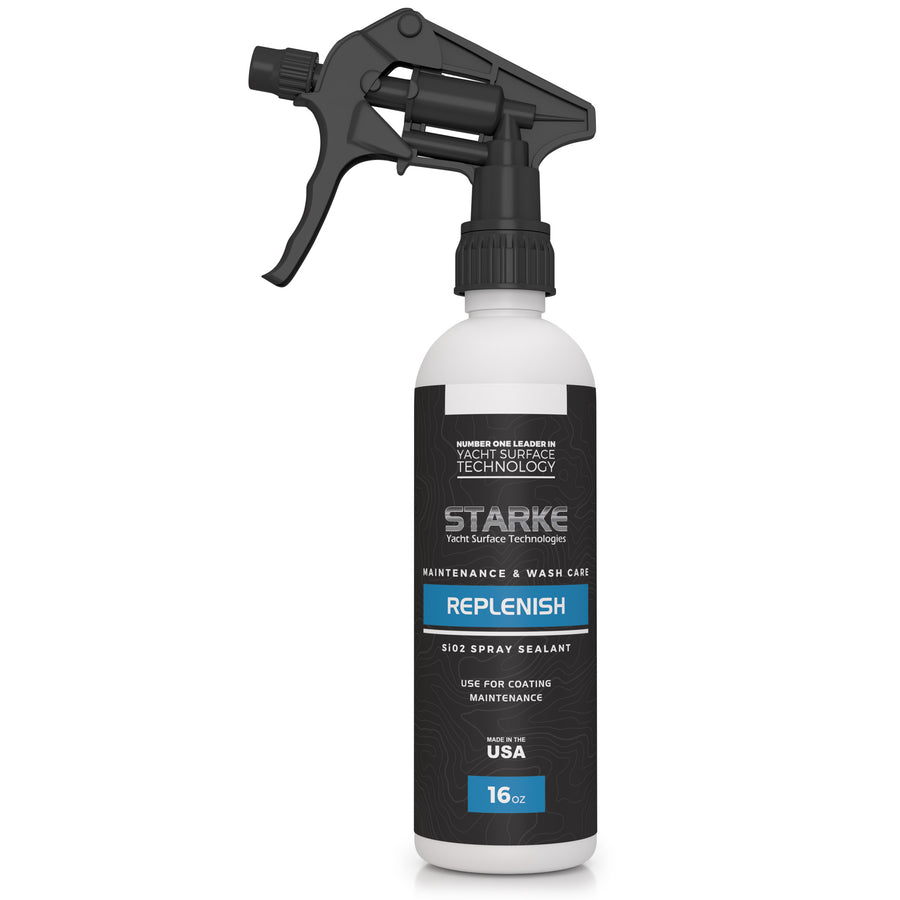
How to Use Starke Replenish to Extend the Life of Your Marine Gel Coat Protection
Your boat's gel coat isn't losing its shine overnight. It's losing a tiny battle every single day.
March 13, 2026
TL;DR: Starke Replenish is a SiO2 silica maintenance spray that refreshes and strengthens any ceramic coating or silica-based sealant on your boat. Apply it every 1–3 months using a simple spray-and-wipe method, or a pump sprayer for larger hulls. It works on gel coat, paint, metal, plastic, and glass. In Antigua's year-round Caribbean sun and salt environment, regular Replenish applications are the single most effective way to keep your protection alive between major details.
Your boat's gel coat isn't losing its shine overnight. It's losing a tiny battle every single day.
Here in Antigua, that battle is intense. The Caribbean UV index regularly exceeds 11 — the threshold considered "extremely high risk" for surface damage — for most of the year. Add relentless salt spray, humidity, and the fact that your boat doesn't get a winter break, and you've got conditions that eat through unprotected gel coat faster than almost anywhere else on earth.
Most boat owners invest in a quality ceramic coating or sealant and then assume the job is done. It isn't. That coating needs to be fed. It needs to be topped up. And the product designed to do exactly that is Starke Replenish.
In this guide, we'll show you what Replenish actually does, how to apply it correctly, how often to use it in Caribbean conditions, and how it fits into the simple maintenance routine that keeps your vessel looking like it just left the yard.
What Is Starke Replenish and What Does It Actually Do?
Starke Replenish is a SiO2 silica spray that acts as a booster and sacrificial outer layer on top of any existing ceramic coating or silica-based sealant. It chemically reinforces the coating already on your hull, adding fresh hydrophobic protection, deeper gloss, and a sacrificial barrier that takes the hit from the elements so your base coating doesn't have to.
Think of it as a booster shot for your boat's finish. SiO2, or silicon dioxide, is the core ingredient in ceramic coatings. When suspended in a liquid carrier and sprayed onto your gel coat, the silica nanoparticles bond to the surface. Water contacts only the very tips of those nanoparticles and rolls off cleanly. Dirt can't get a grip. Salt doesn't stick. Your boat stays cleaner longer, and your coating lasts longer because it isn't fighting alone.
Ceramic boost sprays like Replenish serve as a sacrificial layer of armor. That's the key concept here. They don't replace a full ceramic coating. What they do is sit on top of it and absorb punishment. When UV rays, salt crystals, and abrasive particles come for your finish, they hit the Replenish layer first. That's by design.
The result is a coating that stays thicker, stays more hydrophobic, and lasts significantly longer before it needs professional attention.
Why Replenishment Matters More in the Caribbean
Boat owners in Canada or the northern United States get a natural reprieve every winter. Their vessels come out of the water, go into storage, and give their coatings months to rest. That doesn't happen here.
In Antigua, your boat is in the water year-round. The Caribbean UV index regularly climbs above 13 in the spring months and stays above 7.5 even in December. At levels above 11, surfaces can experience measurable UV degradation in a matter of days, not months.
UV radiation breaks down the molecular bonds in gel coat over time, stripping away the oils and resins that keep surfaces glossy and sealed. Once those bonds weaken, saltwater gets in. When salt dries on your hull, it forms microscopic crystals that attract moisture and accelerate surface degradation. UV and salt are a damaging team on their own. Together in the Caribbean, they're a wrecking crew.
Climate conditions like high temperatures and humidity accelerate the rate of gel coat degradation beyond what UV alone causes. Antigua checks every single one of those boxes, all year long.
What does this mean practically? It means the maintenance schedules written for boat owners in New England or the Pacific Northwest don't apply here. If a product label says "apply every 3 months," boats in Antigua should be closer to every 4–6 weeks on high-exposure surfaces. For marine use in southern states and Caribbean climates, more frequent booster application is specifically recommended compared to northern climates. We aren't in the north. Plan accordingly.
How Do You Apply Starke Replenish? Step-by-Step
Starke Replenish has two application methods. For smaller sections, use spray-on, wipe-off: mist onto a cool, clean surface, work in with one microfiber towel, then remove excess with a second dry microfiber towel. For larger hull surfaces, use a 1-gallon pump sprayer to distribute evenly, hose off, blow dry with a blower, and follow with a mineral-free water rinse. Allow 2 hours to cure.
Here's the full breakdown for both methods.
Method 1: Spray-On, Wipe-Off (Smaller Areas, Spot Treatment)
1. Make sure the surface is cool and clean. Never apply in direct sunlight or on a hot hull.
2. Mist Replenish directly onto the section you're treating.
3. Work the product in using your first microfiber towel. Use a soft, even motion.
4. Use a second clean, dry microfiber towel to remove any excess. Keep this second towel dry at all times.
5. Ultra plush microfibers work best for buffing out the residue.
6. Allow the surface to cure for 2 hours before exposing it to water.
Method 2: Hydro Application (Full Hull, Larger Surface Areas)
1. Fill a 1-gallon pump sprayer with Replenish.
2. Evenly distribute the coating across the hull surface.
3. Hose off the material thoroughly.
4. Use a blower to remove any excess water from the surface.
5. Follow with a rinse using mineral-free water for the cleanest finish.
6. Allow 2 hours for the coating to dry and cure.
Both methods are sourced directly from Starke Yacht Care's official product documentation. The key rule for both: clean surface, cool surface, two microfibers. Don't skip the second towel. It's what separates a clean, glassy finish from streaks.
How Often Should You Apply Starke Replenish?
Starke recommends applying Replenish every 1–3 months, with more frequent use on high-profile areas like the bow, hardtop, and transom. In Antigua and the broader Caribbean, lean toward the shorter end of that window — monthly on exposed surfaces if your boat lives in the water uncovered.
Starke's own maintenance guide recommends applying a SiO2 booster every 2–3 months as part of a proper ceramic coating routine. That guidance is written for general marine use. Antigua isn't general. Your boat faces a harder environment than most.
Your boat will also tell you when it's time. Watch the water behavior on your hull. When water hits a well-maintained SiO2-coated surface, it beads into tight, clear droplets and sheets off. When Replenish starts to wear thin, that beading becomes lazy. Water spreads into a thin film instead of rolling away. That's your signal. Don't wait for a scheduled date. Read the boat.
In environments with heavy UV exposure and no covered storage, ceramic coatings can begin to fail in as little as 9–12 months without regular maintenance boosting. Regular Replenish applications push that timeline out significantly.
One more advantage: Replenish can be layered for increased gloss and protection. If you're doing a full application before a big event, a charter guest arrival, or race week, put down two layers. The second layer bonds over the first and adds both depth and durability.
Can You Use Replenish on More Than Just the Hull?
One of the most practical things about Replenish is how versatile it is. It's safe to use on gel coat, paint, metal, plastic, and glass. That means you can use one product to maintain your entire vessel, not just the hull.
Use it on the helm station. Use it on your stainless rails. Use it on your windows and windscreen. Use it on the hardtop. Anywhere that takes UV and salt exposure, Replenish adds a protective SiO2 layer.
This is a big deal for Caribbean boat owners who are used to buying three or four different maintenance products for different surfaces. Replenish handles them all with the same simple spray-and-wipe process.
For high-traffic or high-gloss areas where you want the absolute best finish, layer it. Two coats of Replenish on your windscreen or helm dash will give you noticeably deeper gloss and stronger water repellency than a single application.
It also works in combination with the full Starke lineup available here in Antigua. After using Starke Venom to remove water spots and rust staining from a surface, follow up with Replenish to lock in fresh SiO2 protection. It's a logical one-two punch that keeps surfaces clean and coated at the same time.
Does Starke Replenish Work Without a Ceramic Coating?
Yes. Replenish works as a standalone silica sealant on surfaces that haven't been ceramic coated. It still delivers hydrophobic protection, improved gloss, and a sacrificial SiO2 barrier. That said, if your boat doesn't have a base ceramic coating yet, you're leaving a significant amount of protection on the table.
Here's the honest picture. On a bare gel coat surface with no base ceramic, Replenish gives you a layer of SiO2 protection. It's a real improvement over nothing. But a full nano ceramic coating chemically bonds to the surface at a molecular level, creating a semi-permanent protective structure. Replenish then sits on top of that structure and reinforces it. The two together are dramatically more effective than either one alone.
If your vessel is currently uncoated, the smart move is to start with a full ceramic coating applied by a professional, and then maintain it with regular Replenish applications. Our certified local detailers can help you get that foundation right. From there, Replenish keeps it performing at its best between services.
A properly applied and maintained ceramic coating with regular SiO2 topping can realistically last 12–24 months in active saltwater use. Without regular boosting, that timeline shortens considerably. Replenish is the tool that keeps the clock running.
Replenish and the Bigger Picture: A Simple Maintenance Routine That Works
Replenish isn't a standalone product. It's one part of a simple routine that keeps your boat looking sharp without requiring a major detailing session every few weeks.
Here's how we recommend building that routine for Antigua conditions:
Weekly or bi-weekly: Rinse with fresh water after every salt exposure. Salt that dries on your hull forms crystals that accelerate wear on any coating. A rinse takes five minutes and saves you hours of corrective work later.
Monthly: Wash the full boat using a pH-neutral soap that won't strip your sealant. Starke Pure Clean is designed specifically for this, and we carry it here at Antigua Marine Solutions. Use a soft microfiber wash mitt, never a brush.
Every 1–3 months: Apply Starke Replenish to the full vessel. Focus extra attention on the bow, hardtop, transom, and waterline — the surfaces that take the most direct UV and impact. Monthly is better for boats left uncovered in full sun.
Annually: Schedule a professional detail and inspection. This typically involves a light polish to restore any lost gloss, a full decontamination wash, and a fresh top-up ceramic layer applied over your existing coating.
Ceramic coatings make boat maintenance easier, not maintenance-free. That's the honest truth. The good news is that with Replenish in your kit, the "maintenance" part is genuinely simple. Spray it on, wipe it off, and let it work. Your hull will thank you for it.
Conclusion
Three things to take away from this guide.
First, Replenish every 1–3 months is the single easiest step you can take to dramatically extend the life of your ceramic coating or silica sealant. It's not optional if you want your investment to last.
Second, Caribbean conditions demand a tighter schedule than most product guides are written for. Antigua's UV, salt, and heat are relentless. Apply Replenish more frequently on high-exposure surfaces and always rinse your boat after every salt-water outing.
Third, the two-microfiber technique is essential. Work it in with one towel, remove the excess with a clean dry second towel. That one detail separates a streak-free, glassy finish from a frustrating redo.
Your boat lives in one of the most beautiful places on earth. It also faces some of the harshest conditions on the planet. Protect it accordingly.
Frequently Asked Questions
Can I apply Starke Replenish over a wax?
We don't recommend applying Replenish over a traditional carnauba wax. Wax creates a film that interferes with the SiO2 chemistry's ability to bond and perform correctly. For best results, use Replenish over a clean, wax-free surface that has been treated with a ceramic coating or silica-based sealant. If your boat is currently waxed, a thorough decontamination wash before applying Replenish will give you the best outcome.
How long does Starke Replenish take to cure?
Starke Replenish requires approximately 2 hours to dry and cure after application. Keep the treated surfaces dry during that window. For the hydro application method, use a blower after hosing off the material to speed up the drying process before the final mineral-free water rinse. In Antigua's warm temperatures, curing tends to happen efficiently.
What's the difference between Starke Replenish and Hydro Guard?
Both are SiO2 maintenance sprays and both serve the same purpose of topping up your ceramic coating protection. Starke's own maintenance guide lists both Replenish and Hydro Guard as appropriate SiO2 boosters. Replenish is the product we carry and recommend here at Antigua Marine Solutions. It's safe on gel coat, paint, metal, plastic, and glass, making it the most versatile option in the lineup for full-vessel maintenance.
Do I need to remove old Replenish before reapplying?
No. One of the key advantages of Replenish is that it can be layered. Replenish can be applied over existing applications for increased gloss and protection. Simply ensure the surface is clean and cool before your next application. A routine monthly wash with a pH-neutral soap like Starke Pure Clean is all the prep you need before reapplying Replenish on schedule.
Can I apply Starke Replenish in direct sunlight?
Avoid it. Applying any SiO2 spray or ceramic maintenance product to a hot or sun-warmed surface causes the product to flash dry too quickly. That leads to uneven bonding, streaking, and reduced performance. Always work in the shade or during the cooler parts of the day, especially here in Antigua where hull surface temperatures can climb well above ambient air temperature. Early morning is ideal.
Featured Product
Starke Replenish