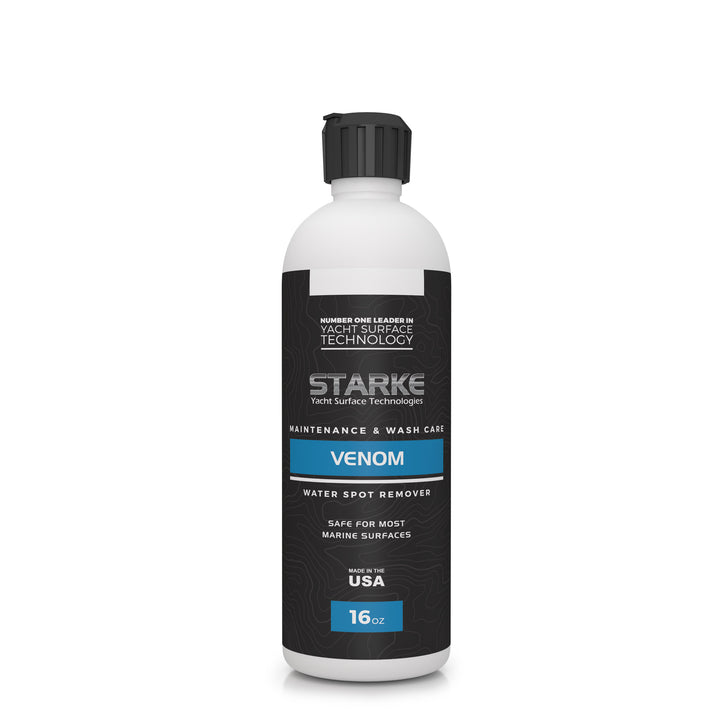
How to Use Starke Venom to Remove Rust Stains from Your Boat
In Antigua's tropical, saltwater environment, rust isn't rare. It's relentless.
March 13, 2026
TL;DR: Starke Venom is a next-generation water spot and rust stain remover that gels to your boat's surface and chemically dissolves mineral deposits and iron oxide without scrubbing. It's safe on gel coat, paint, glass, metal, and ceramic-coated surfaces. Apply a few drops to a microfiber cloth, work it across the affected area in 2x3 foot sections, let it dwell for 2-5 minutes, then wipe clean. In Antigua's saltwater environment, Starke Venom belongs on every boat.
You know what it looks like. Brown streaks weeping down a white hull from a stainless cleat. An orange bloom on the gel coat where the anchor chain sat for an hour. You rinsed the boat. You scrubbed it. The stain came right back.
In Antigua's tropical, saltwater environment, rust isn't rare. It's relentless. Even 316-grade marine stainless steel, the industry standard for boat hardware, is corrosion-resistant but not corrosion-proof. Salt air, standing water trapped under fittings, and the warm climate work together to accelerate the oxidation process that leaves those familiar orange and brown stains behind. And unlike boat owners in cooler climates who get a natural break in winter, Antigua boat owners deal with this twelve months a year.
Most people reach for household chemicals or harsh acids when they see rust. That's the wrong call. It trades one problem for a worse one. Starke Venom is the right tool. This post explains exactly what it does, how to use it correctly, and why it outperforms every DIY alternative you've probably already tried.
What Is Starke Venom and How Does It Work?
Starke Venom is a next-generation water spot and rust stain remover with a unique gel formula that clings to your boat's surface and chemically dissolves mineral deposits and iron oxide without any scrubbing. It's safe on ceramic coatings, gel coat, paint, glass, and metal, and it delivers results other products simply can't match without damaging the surfaces underneath.
The formula gels to the substrate where it begins to lightly eat away at minerals and other contaminants. That word "eat" is intentional. Venom isn't abrading the stain off the surface. It's chemically breaking down the iron oxide and mineral deposits at the molecular level and dissolving them. That's what makes it a new-generation product. It attacks the problem, not the surface.
Professional detailers describe it as voted the best water spot and stain remover on the market, in a class of boat detailing products that literally eats minerals and other contaminants while not harming paint or gel coat finishes. That distinction matters, especially when you're dealing with gel coat that has years of Caribbean sun baked into it.
Venom also has a bonus use. Once you've finished cleaning, it works as a pre-wipe before buffing or light polishing. Starting with a surface cleaned by Venom means you begin polishing on a perfectly clean substrate, which saves time and produces a better finish. One product that earns its space twice.
Why Rust Is So Hard to Escape in Antigua
Rust on boats isn't a maintenance failure. It's chemistry. When iron or steel is exposed to oxygen and moisture, it corrodes. Those resulting iron oxide particles get washed down your boat's surfaces, embedding themselves into the gel coat and leaving stains that feel impossible to remove. In the marine environment, that exposure is continuous.
The sneaky part is that the stains usually don't come from the metal itself failing visibly. They come from crevice corrosion: a process where water gets trapped beneath hardware like cleats, rails, and screw heads, becomes stagnant, loses oxygen, and causes the normally passive stainless steel to become "active" and corrode. The rust then weeps outward across your deck or topsides.
The other common culprits are anchor chains and anchor lockers, iron-rich dock water, and low-grade hardware used by some builders to keep costs down. Boats in warmer climates are more likely to experience corrosion than boats in cooler climates. Antigua sits firmly in that category. Warm water, year-round humidity, and constant salt exposure create exactly the right conditions for iron oxide to form, spread, and embed.
Left alone, rust stains don't just sit there. Iron particles penetrate porous gel coat surfaces, and the Caribbean sun bakes them in deeper over time, making early treatment critical. For more on keeping your boat in top shape in these conditions, our guides cover the full picture.
Why You Should Never Use Muriatic Acid or Household Chemicals on Your Boat
Muriatic acid removes rust stains, but it creates damage that costs far more to fix. It can cause irreversible harm to skin, lungs, and eyes, and it's aggressive enough to etch gel coat, corrode aluminum, and strip protective coatings. Household toilet bowl cleaners and DIY acids give you a quick visual result while quietly degrading the surfaces you're trying to protect. Starke Venom operates within safe pH parameters that clean the stain and leave your boat's finish intact.
Muriatic acid can cause permanent scarring, respiratory problems, and blindness from even the smallest contact, and it's not recommended for anyone other than a professional. That's before you consider what it does to the boat itself. On gel coat, muriatic acid causes yellowing and can break down surface integrity. On aluminum, it causes whitening and etching. On stainless fittings, aggressive acids strip the thin passive chromium oxide film that gives stainless its corrosion resistance. Once that layer is gone, the metal corrodes faster than it did before.
The damage from household chemicals is often invisible at first. You clean the stain, the hull looks good, and two months later the rust is back worse than ever. That's because the surface has been weakened. Its natural protection has been stripped away and what's left is a more porous, less defended surface that rust can penetrate more easily the next time around.
Rust and water spots are chemical processes that actively damage boat surfaces when left untreated, and traditional approaches using harsh acids create long-term damage that often exceeds the original problem. Venom was built specifically to solve this. It cleans thoroughly, at a pH level safe for all surfaces, without doing the secondary damage that makes the problem worse over time.
How Do You Apply Starke Venom? Step-by-Step
Shake the bottle, ensure the surface is cool and shaded, apply a few drops to a microfiber cloth, work in 2x3 foot sections using straight or circular strokes, let dwell for 2-5 minutes, and wipe clean with a fresh microfiber cloth. Don't let Venom dry on the surface. Wear gloves, as the formula contains an acid that's safe for all substrates but can irritate skin.
Here's the full process:
Step 1: Pre-wash the surface first. Always clean the boat with a good quality soap before using Venom. Dust and dirt particles on the surface will scratch your finish during application. A proper prewash and rinse ensures particles are removed so scratches and swirl marks are prevented. This isn't optional. It's how professional detailers work.
Step 2: Work in shade on a cool surface. Heat causes the formula to dwell unevenly. Choose early morning in Antigua whenever possible. Your boat's surfaces are cooler, and the dew has usually just evaporated, leaving you with the ideal application window.
Step 3: Shake the bottle well. This ensures the gel formula has an even consistency before application.
Step 4: Apply directly to a microfiber cloth or the affected surface. Apply a few drops of Venom onto a microfiber cloth and start applying it to the surface. For rust stains on hull topsides, you can apply directly to the area for maximum concentration. The gel-like consistency will cling to vertical surfaces and stay in place rather than running off.
Step 5: Work in 2x3 foot sections. Use straight or circular strokes, ensuring even coverage. Move section by section across the affected area. Don't try to cover the whole hull at once.
Step 6: Let it dwell. Allow the formula to sit for 2-5 minutes. Venom will begin to break down water spots, mineral deposits, and contaminants. Keep an eye on the surface. If it starts to look like it's drying, move to the next step immediately.
Step 7: Wipe clean with a fresh microfiber cloth. For stubborn deep rust stains, a second application is fine. Don't try to scrub harder; let the chemistry do the extra work instead.
Step 8 (optional): Use as a pre-polish wipe. If you're buffing or polishing after, Venom has already done the prep work for you. You're starting on a perfectly clean surface.
Want to watch Venom in action before you start? Our videos show the process on real boat surfaces.
Where to Use Starke Venom on Your Boat
Venom is one of the most versatile products in the marine detailing world. Here's where it works on an Antigua-based boat, and the few surfaces where you'll want to be careful.
Hull topsides. This is where rust tears and tannin stains are most visible. Brown streaks from cleats, orange patches from chain contact, and the general discolouration that comes from months in a saltwater marina. Venom handles all of it.
Stainless steel hardware. Rails, cleats, winches, cleats, rod holders, and any other deck hardware. Apply directly, let it dwell, and wipe clean. Water spots disappear on contact, and rust staining responds quickly to even a single application.
Gel coat deck surfaces. Anchor locker surrounds, cockpit floors, and any non-skid surfaces where chain or tools have sat and left residue.
Glass ports and windshields. Mineral deposits from saltwater spray etch into marine glass over time. Venom dissolves them cleanly without scratching.
Painted metal surfaces. Railings, mast bases, and other painted areas that show rust bleed from underlying hardware.
Surfaces to avoid: Never use Venom on MFD chartplotter screens, as it will strip their UV coatings. Avoid raw uncoated aluminum, as it may cause whitening. Test in an inconspicuous area first on anodized surfaces.
For a full surface maintenance approach, explore the complete Starke lineup available at Antigua Marine Solutions.
Can You Use Starke Venom on a Ceramic-Coated Surface?
Yes. Starke Venom is specifically formulated to be safe on ceramic-coated finishes. It removes contamination without stripping or degrading the coating underneath. Most professional cleaning products are not ceramic-safe, which makes Venom a rare and genuinely useful tool for owners who have invested in a ceramic coating.
Venom is a new-generation water spot remover that is safe to use on finishes that have been ceramic coated. This matters more than most boat owners realize. When a ceramic coating appears to have failed (lost its water-beading, looking dull, not performing), the problem is often contamination buildup rather than coating failure. Performing a strip wash with Venom first often resolves what looks like a coating failure; it's contamination that proper cleaning easily clears.
For the strip wash technique on large hull areas, dilute Venom in a bucket and apply across the hull surface with a soft brush. This removes rust, mineral deposits, and salt contamination across the entire hull while maintaining the coating integrity underneath.
Once your hull is clean with Venom, follow up with Starke Replenish to restore the SiO2 protective layer and keep your ceramic coating performing at full strength. Clean it with Venom. Protect it with Replenish. That's the routine that keeps Caribbean boats looking their best.
Conclusion
Three things to take away from this guide.
First, rust in Antigua is a year-round chemical reality, not a maintenance failure. The salt, the heat, and the constant moisture create conditions that accelerate iron oxidation on every boat in the water. Getting ahead of it requires the right product.
Second, Starke Venom's gel chemistry dissolves rust and mineral deposits without scrubbing and without damaging your gel coat, paint, or ceramic coating. It outperforms every household alternative, and it doesn't create the secondary damage that makes the problem worse over time.
Third, application is simple. Prewash, apply cool and in shade, dwell 2-5 minutes, wipe clean. That's all it takes to restore a hull that looks like it's been losing the rust battle for years.
Your boat works hard in one of the most beautiful places on earth. It deserves products that work just as hard.
We're Antigua Marine Solutions, and we know what boats go through in this part of the world. From one boat lover to another: get Venom on your vessel.
Frequently Asked Questions
Can I use Starke Venom on rust stains from anchor chain on my deck?
Yes. Anchor chain is one of the most common causes of rust staining on Caribbean boats. Iron particles from the chain transfer to gel coat and deck surfaces and oxidize quickly in the saltwater environment. Starke Venom is safe on all gel coat surfaces and is specifically designed to dissolve iron oxide deposits. Apply it directly to the stained area, let it dwell for 2-5 minutes, and wipe clean. For deep-set staining, a second application works better than scrubbing harder.
How long do I let Starke Venom sit on a rust stain before wiping?
Allow the formula to sit for 2-5 minutes on the affected area. For water spots, the result is often almost immediate. For rust staining, the full dwell time gives the formula time to chemically break down the iron oxide. Keep watching the surface during this window: if Venom starts to dry before the dwell time is up, wipe it off immediately. Letting it dry on the surface can cause damage to metals, plastics, and glass.
Is Starke Venom safe on stainless steel hardware?
Yes. Starke Venom is effective on stainless steel and painted metals, removing rust staining and mineral deposits without harming the metal itself. This is an important distinction from harsh DIY alternatives. Aggressive acids like muriatic acid strip the passive chromium oxide film that gives stainless its corrosion resistance, making it more vulnerable afterward. Venom operates within safe pH parameters that clean the stain without compromising that protective layer.
Do I need to wash the boat before using Starke Venom?
Yes, always. Conduct a prewash and rinse before application to ensure dirt particles are removed, so scratches and swirl marks are prevented. Any dust, salt crystals, or grit on the surface will act as an abrasive between the cloth and your gel coat during application. It only takes a few minutes and it protects your finish from unnecessary damage.
Can Starke Venom damage my boat's gel coat if I leave it on too long?
It can if you allow it to dry completely on the surface. Do not allow Starke Venom to dry to the surface of the vessel, as this can cause damage to metals, plastics, and glass. Always monitor the surface during the dwell period and wipe it clean before it dries. Working in 2x3 foot sections rather than large areas at once makes this easy to manage, especially in Antigua's heat. If you're unsure, start with a 2-minute dwell time and increase on the next pass if needed.
Featured Product
Starke Venom Rust Stain Remover